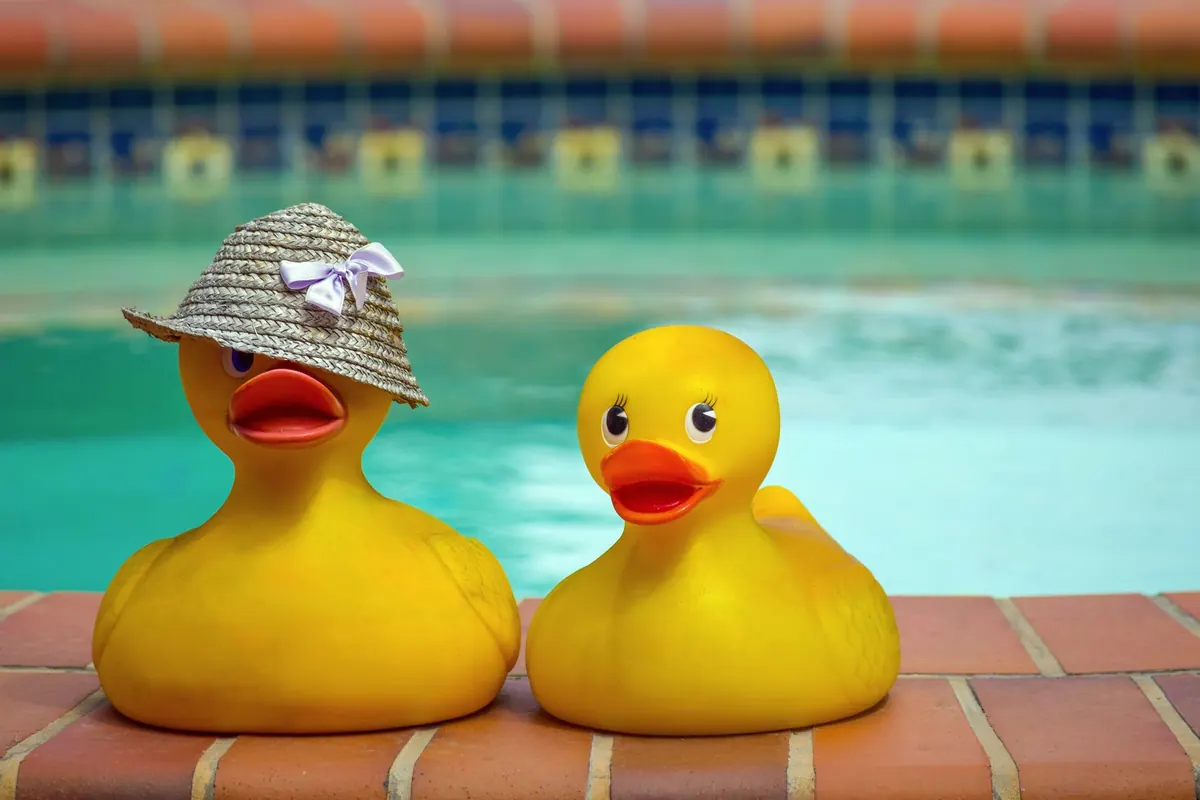
Few objects in a home do as little and mean as much. It sits by the taps, squeaks when squeezed, and takes up about as much space as a bar of soap. Yet the yellow bath duck has been a stage for children's stories, a muse for songwriters and sculptors, and — briefly, in 1992 — an accidental fleet of drift markers for oceanographers. Its history is smaller, and stranger, than the object suggests.
From Vulcanized Rubber to the Bathtub
Bath toys are older than the rubber duck. Wooden and tin figures floated in washbasins long before anyone thought to make a bird out of rubber. What changed things was chemistry: once rubber could be stabilized and shaped reliably in the nineteenth century, manufacturers began pressing it into small, cheap, hollow toys. Early floating ducks were often painted rather than dyed, and plenty of them behaved badly in water — tipping over, taking on water, or losing their paint after a few weeks of use.
The duck we recognize is a mid-twentieth-century piece of design engineering. To float upright, a hollow toy needs a low center of gravity: a flat or weighted base, a body that sits deep enough in the water, and a shape that stays stable when a child pushes it under. To squeak, it needs a small reed or whistle in the beak and a body soft enough to compress. To be manufactured cheaply, it needs a mold with as few parts as possible. The yellow, upright, squeaking duck solves all four problems at once, which is why the design barely changed for decades.
The American sculptor Peter Ganine patented a floating bath duck in the 1940s, and the design was licensed and produced in large numbers. Ganine's version is often credited with popularizing the now-familiar silhouette: rounded body, flat bottom, beak tilted slightly upward.
Why Yellow, and Why the Squeak Matters
Yellow was not inevitable. Rubber ducks have been made in red, blue, pink and natural rubber gray, and early catalogues show ducks painted with orange bills and black eyes over a pale body. But yellow has three practical advantages: it matches the duckling it imitates, it hides the yellowing that old rubber and plastic develop, and it reads instantly in a photograph. When manufacturers began injection-molding the toy in the 1950s and 1960s, bright yellow pigment became the default.
The squeak deserves more credit than it gets. It is the cheapest possible interactive feature — a tiny bit of air and a reed — and it turns a floating object into a responsive one. A baby squeezes; the duck answers. That loop is the whole toy, and it is why the duck survives trends that have buried more elaborate bath gadgets.
A Song Made It Famous
The rubber duck was already a household object when Sesame Street gave it a anthem. In 1970, Ernie's ode to his bath toy — written by Jeff Moss — turned a bathroom prop into a character with feelings and a fan club. The song charted, which is an odd thing for a song about a bath toy, and it did something no advertisement could: it made the duck funny, slightly ridiculous, and affectionate all at once.
That tone stuck. Since then the duck has been a shorthand for harmless absurdity — the thing you put on a desk, in a goody bag, or on top of a birthday cake when you want a smile without saying anything.
The Container That Went Overboard
In January 1992, a container ship crossing the Pacific from Hong Kong toward the United States lost part of its deck cargo in a storm. Among the containers was one full of bath toys — ducks, frogs, turtles, beavers — packed for the American market. Thousands of them went into the water.
What followed made the toys briefly famous for something other than bathing. Beachcombers along the coast of Alaska and the Pacific Northwest started finding them, years later and hundreds of miles from where they entered the sea. Oceanographer Curtis Ebbesmeyer, who studied drifting debris, and a network of beachcombers used the finds to trace surface currents, including the slow loop of the North Pacific. The ducks became a lesson in how the ocean moves: not as a smooth conveyor, but as a messy set of eddies that can carry a plastic bird for a decade before dropping it on a beach.
Art, Racing, and Ducks on Jeeps
The toy's second life is as a cultural prop, and it has had an unusually productive one.
- Public art. The Dutch artist Florentijn Hofman began installing enormous inflatable ducks in harbors in 2007. The scale does the work: a duck the size of a building, bobbing in a shipping channel, is funny and slightly unsettling at the same time.
- Charity races. Numbered ducks released into a river or a pumped channel, with the first one past the line winning a prize, have become a standard fundraising format in many towns. The appeal is that the race is genuinely unpredictable and costs almost nothing to watch.
- Jeep ducking. A recent habit of leaving small ducks on parked Jeeps, often with a note, has spread through owner communities as a low-stakes way of saying hello.
- Rubber duck debugging. Programmers describe a habit of explaining code, line by line, to an inanimate duck on the desk. The duck never answers, which is the point: saying the problem out loud often reveals the error.
Keeping a Bath Duck Worth Keeping
Most bath ducks lead short, inglorious lives: bought, squeezed, left in a puddle, forgotten behind the shampoo. A few small habits get much more out of one — and keep it from becoming a science experiment.
- Check the base before you buy. If there is a hole or a slit underneath, water will get inside, and once it is in, it is very hard to get out. Sealed toys stay cleaner; vented ones squeak.
- Empty it after every bath. Squeeze the body a few times under clean water, then squeeze the water out, shake it, and leave it to drain hole-down on the edge of the tub or on a small rack.
- Store it dry, not damp. A toy that sits in a wet sponge or a closed caddy never dries. Air movement matters more than any cleaning product.
- Look inside. If you can see dark patches or a smell that does not rinse away, replace the toy. Interior surfaces of a vented toy cannot be scrubbed properly.
- Match the toy to the child. For babies who put everything in their mouths, check the age guidance on the packaging and prefer toys with no small detachable parts. A squeaker can be a choke hazard if it comes loose.
- Keep the collector editions out of the water. Painted or flocked novelty ducks are display pieces. A plain, well-made bath duck is the one that will survive daily use.
A duck costs almost nothing and asks for almost nothing. Give it a rinse, a squeeze, and somewhere to dry, and it will sit by the taps for years — squeaking on demand, holding its place as the cheapest possible reminder that curiosity does not need to be complicated.
Photo: Thomas Parker / Pexels